Pillow materials and sleep comfort
Travel Pillow Materials and Shapes: What Matters on Long Journeys
A travel pillow has a small job with surprisingly large consequences: it must fit the journey, the body, and the limited space in a bag or seat. Its shape influences how it supports the head and neck; its fill affects weight, feel, and packability; and its cover and care instructions determine whether it is practical to take along again and again.
On a long flight, train ride, or drive, the best choice is not necessarily the softest pillow or the one with the most elaborate construction. It is the one that suits how you rest, where you intend to use it, and what you are willing to carry and maintain. Understanding the trade-offs between travel pillow materials and shapes makes it easier to choose with clear expectations.
Start with the journey, not the label
Travel is a shifting environment. A pillow that feels comfortable at home may be cumbersome in an airplane seat; one that packs neatly may offer too little support for a sleeper who needs a stable place to rest. Before comparing fills, think about the journey itself. Will you be seated for several hours, leaning against a window, trying to sleep upright, or using the pillow in a hotel after arrival? Will it travel in a roomy suitcase or need to fit into a small day bag?
Also consider how you usually fall asleep. Some people rest their head against a seat or wall. Others lean forward, turn to one side, or use a pillow behind the lower back. A travel pillow should respond to that real habit, not an imagined ideal posture. If you rarely sleep sitting up, a neck ring may not be useful simply because it is a familiar travel shape. A small rectangular cushion or an adjustable pillow may be more versatile.
Make a short list of priorities before shopping: neck stability, a soft surface against the face, low weight, a compact packed size, easy cleaning, or usefulness beyond the trip. It is difficult for one design to excel at all of them. Prioritizing two or three helps make the trade-offs manageable.
How shape changes support
Shape determines where a pillow meets the body and how it behaves when you move. A travel pillow can be soft and well made yet still feel wrong if it leaves a gap where support is needed or pushes the head into an uncomfortable angle.
U-shaped neck pillows
The familiar U shape sits around the neck, with its ends near the front of the shoulders. Depending on the person and the pillow’s height, it may help limit sideways head movement while sitting upright. Some designs fasten or connect at the front, which can make the pillow feel more secure. Others are open and flexible, allowing a little more freedom to reposition.
Fit matters. A pillow that is too tall can push the head forward, while one that is too loose may shift as the sleeper nods off. The seat itself also changes the result: a high seat back, headrest wings, or a narrow shoulder space may affect where the pillow can sit. Try to imagine the pillow in the actual position you will use, rather than judging it only in a shop or at home.
Compact cushions
A small rectangular or square travel cushion offers flexibility. It can be placed behind the neck, against a window, across the lap, or behind the lower back. This adaptability can be useful when a trip includes several settings, or when a traveler prefers to control the angle of support. Its limitation is that it may not stay in place on its own, especially in a seat where the body shifts during sleep.
Size is part of the design. A cushion should be large enough to support the area it is intended for, but not so bulky that it becomes awkward to carry. Some compact travel pillows are sized for a short rest rather than full head support; reading dimensions and checking whether a cushion pad is included can help avoid surprises.
Contoured and wraparound designs
Contoured pillows use shaped sections to cradle particular areas, such as the neck or the sides of the head. Wraparound designs aim to provide more contact than a simple cushion, and some include a closure to reduce slipping. They can feel stabilizing for some travelers, though the extra structure may make them less adaptable or more difficult to pack.
Contours are not automatically better for every body. A curved section must align with the user’s neck and shoulders to feel supportive. If its shape does not match, it may create pressure rather than relief. Because bodies and seat positions vary, consider dimensions, adjustability, and return or trial policies where available.
Travel pillows for more than the neck
Some travel pillows are designed as compact cushions rather than neck supports. A boudoir-size pillow, for example, may serve as a soft surface for the head or as a small support in a hotel room. A dedicated neck pillow, by contrast, is shaped for use around the neck and may be less useful for other purposes. The distinction is simple but important: choose based on the job you want the pillow to do most often.
What different materials feel like
Fill influences a travel pillow’s weight, resilience, temperature, and ability to compress. The cover matters too: it is the surface against the face, and it may be the part that is easiest to wash after a journey. Product descriptions sometimes use broad terms such as “soft,” “supportive,” or “cool.” These words can help set expectations, but they are not standardized measurements. Look for concrete details about materials, construction, and care.
Fiber fills and down alternatives
Polyester and other fiber fills are common in pillows designed to feel light and soft. They can be suitable for a compact cushion, though their resilience varies with the type and amount of fill. A loosely filled pillow may compress under the head, while a denser construction may hold its shape better but take up more space. If a pillow is described as down-alternative, check whether the fill is fiber, a blend, or part of a more complex layered construction.
“Down-free” describes an absence of down, but it does not tell you whether a pillow is hypoallergenic, washable, or suitable for a particular sensitivity. People who have allergies should check the full material information and care guidance rather than relying on a general label. A removable washable cover can be useful, but washing the cover is not the same as cleaning the pillow’s inner fill.
Memory foam
Memory foam is often used in contoured or structured travel pillows. It can provide a more stable, close-fitting feel than loose fiber fill, and it may return to its original form after pressure is removed. However, foam products differ in density, flexibility, and how much they compress. A solid foam core can be bulky, and some designs are not meant to be machine washed. Check whether the cover comes off and whether the foam itself has specific cleaning restrictions.
Foam can also feel warmer than a highly breathable, loosely filled cushion for some sleepers. Cover fabric, room temperature, and personal comfort all play a part. If you tend to overheat, look for clear information about the cover’s weave and the manufacturer’s care instructions rather than assuming that a cooling claim will suit every traveler.
Natural fibers and specialty fills
Wool, cotton, kapok, and silk each bring different characteristics to bedding, but a material’s presence alone does not predict how a travel pillow will perform. Wool may feel resilient and substantial; cotton fill can feel more structured than airy; kapok is a plant-based fiber used in some adjustable pillows; and silk may be used as a surface material or a fill. The construction, amount of material, and shape remain just as important as the fiber name.
Specialty materials can also affect care. Some pillows are spot-clean only, while others have removable covers or machine-washable components. Natural does not mean carefree, and a washable outer case does not necessarily mean the whole pillow can go into a washing machine. Read the label before traveling, especially if you expect to use the pillow frequently.
Silk and compact travel cushions
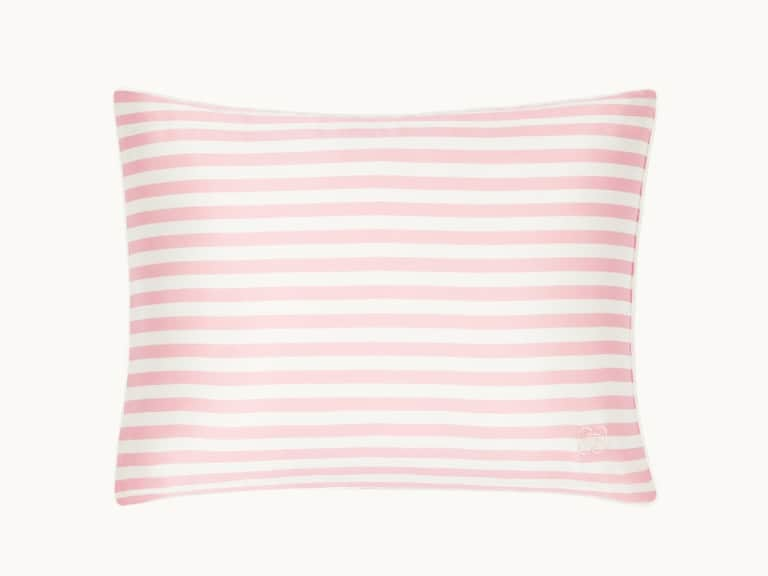
Silk is often chosen for its smooth feel against the skin. For a small cushion, the shell, inner casing, and fill should be considered separately. One example is the Silk Travel Pillow in Pink and Ivory Stripe, which has a 19-momme mulberry silk outer surface, a cotton sateen inner casing, and filling made from long-strand mulberry silk wrapped around a polyester core. That combination illustrates why “silk pillow” can describe more than one part of a product’s construction.
This type of compact cushion may suit someone who values a smooth surface and wants a small pillow for travel. It is not the same thing as a wraparound neck-support design, so travelers should consider whether a cushion format matches their preferred resting position. Its stated care guidance is also part of the decision: delicate washing, mild detergent, and air drying call for more attention than a pillow that can be washed as a complete unit.
Packability: the pillow in the bag and in the seat
“Packable” can mean several things. A pillow might be physically small, lightweight, compressible, or supplied with a way to attach it to luggage. These properties are not interchangeable. A light pillow may still occupy a lot of space; a compressible one may recover slowly or feel too thin after being packed. Dimensions, weight, and construction provide a more useful picture than a general portability claim.
Think about how the pillow will be carried during the entire trip. Will it be tucked into a backpack, attached to a suitcase, or held during boarding? Can it be compressed without damaging the fill or foam? Does it have a storage bag, and is that bag included? If you travel with limited luggage, a simple cushion that can serve more than one purpose may be more practical than a highly specialized shape.
Packability also interacts with support. A very small pillow may be easy to carry but too narrow to stabilize the head. A taller, more structured pillow may work well in a seat yet be harder to stow. The right balance depends on the length of the journey and the likelihood that you will actually use it. A pillow left at the bottom of a bag because it is cumbersome offers little comfort.
Care on the road
Travel pillows encounter more than a bed pillow normally does: shared seating, luggage compartments, changing temperatures, and long stretches between laundry days. A removable cover can be valuable because it separates the washable surface from the inner pillow. Before packing, confirm which parts can be washed, what temperature is recommended, and whether the pillow must air-dry fully before it is used or stored.
Care labels should take precedence over general advice. Foam cores may need spot cleaning rather than immersion. Silk and other delicate fabrics may require gentle washing or air drying. Some fiber-filled pillows can be machine washed, while others cannot. If the care instructions are unclear, avoid assuming that a pillow is washable simply because its cover is removable.
For longer trips, a clean pillowcase or protective cover can help keep the pillow’s surface separate from luggage and shared environments. A protective cover is not a substitute for cleaning, but it can make routine care easier. When you return home, unpack the pillow, inspect the care label, and allow it to air out if the materials and manufacturer’s guidance permit.
A simple way to compare options
Product descriptions can be difficult to compare when one emphasizes fill, another emphasizes shape, and a third foregrounds a fabric finish. Use the same questions for every option. The goal is not to find the most impressive specification; it is to understand how the pillow is likely to work in your travel routine.
- What is the main use? Neck support, a small head cushion, a back support, or a pillow for a destination stay?
- What is the shape? U-shaped, contoured, rectangular, or another format—and does it suit the way you rest?
- What is inside? Fiber, foam, natural fill, or a combination? Is the fill fixed or adjustable?
- What touches your face? Check the cover material, texture, and whether it can be removed.
- How does it pack? Look for dimensions and weight, and find out whether it can be compressed or comes with a storage method.
- How is it cleaned? Separate the care instructions for the cover and the inner pillow.
- What is the evidence behind claims? Treat broad terms such as “cooling,” “supportive,” or “hypoallergenic” as claims to investigate, not guarantees of personal comfort.
When possible, test the pillow in a seated position resembling the one you expect to use. Notice whether it lifts the chin, leaves a gap behind the neck, presses on the jaw, or shifts when you relax. A few minutes of testing will not reproduce a long journey, but it can reveal an obvious mismatch in height or shape.
Common travel-pillow myths
“A neck pillow works for everyone.” It does not. Neck proportions, seat shape, posture, and preferred sleeping position all differ. A U-shaped design is one option, not a universal solution.
“The softest pillow is the most comfortable.” Softness can feel pleasant at first, but a pillow that collapses may not provide the stability a traveler wants. Support and comfort are related, but they are not identical.
“Natural materials are automatically allergy-safe.” A material’s source does not establish how an individual will react. Sensitivity varies, and labels such as “natural” or “hypoallergenic” should not replace checking the actual materials and consulting a qualified health professional when needed.
“A removable cover means the pillow is machine washable.” Often, it means only the cover can be washed. The core may have separate restrictions, so always check the care label.
“Small means easy to travel with.” A pillow can have compact dimensions but still be awkward to carry, difficult to attach, or inconvenient to use. Consider the whole trip, from packing to the seat to cleaning at home.
Choose for the real trip
The most useful travel pillow is not defined by a single fill or silhouette. It is the one that supports the way you rest, fits the space you have, and can be cared for without turning a simple journey into another packing problem. A compact cushion can offer versatility; a shaped neck pillow may feel more secure; a foam design can hold a defined contour; and a fiber-filled option may prioritize softness and lightness. Each brings its own balance of advantages and compromises.
Read material and care details closely, consider how the pillow will sit against your body in the seat, and be realistic about how much space you can spare. Comfort is personal, but good selection begins with specific questions. When shape, fill, portability, and maintenance all fit the journey, a travel pillow becomes more than an accessory: it becomes a small, practical piece of support carried from one place to the next.
Quick guide to travel pillow choices
For seated neck support
Compare U-shaped and contoured designs for height, fit, and how securely they stay in place. Check that the shape does not push your head forward.
For flexible use
A compact cushion may be repositioned behind the head, neck, or back. Consider whether it will stay put in the seat and whether its size provides enough support.
For low-maintenance travel
Look for straightforward care instructions and a removable cover, while checking whether the inner pillow has separate washing restrictions.
For lighter packing
Compare actual dimensions and weight, not just portability claims. A compressible design may save space, but check whether it regains its useful shape after packing.